
Designing Collette Health's first AI-driven feature to verify sitter presence, support clinical accountability, and establish a responsible foundation for future AI capabilities.
The Challenge
Hospitals rely on virtual sitters to prevent falls, reduce adverse events, and support overstretched nursing teams. As virtual observation programs expand, leaders need confidence that sitters remain present and attentive across multiple patient feeds.
Without automated verification, teams depend on manual audits, inconsistent oversight, and trust alone. This creates operational challenges around performance, compliance, and the ability to scale virtual observation programs responsibly.
The opportunity was to use AI to strengthen accountability without creating an intrusive or punitive monitoring experience.
Defining AI's Role
I led the design and product strategy for Collette Health's first AI-driven feature: Sitter Presence Detection (SPD).
The guiding principle was straightforward: AI should augment people, not replace them. Rather than treating AI as a standalone technology layer, we focused on automating routine verification, improving contextual awareness, and supporting existing clinical workflows.
SPD was designed to answer one foundational question: Is the sitter present and attentive?
That clear scope helped translate computer vision into a practical product capability with defined behaviors, understandable controls, and a path toward future enhancements.
Designing the Workflow
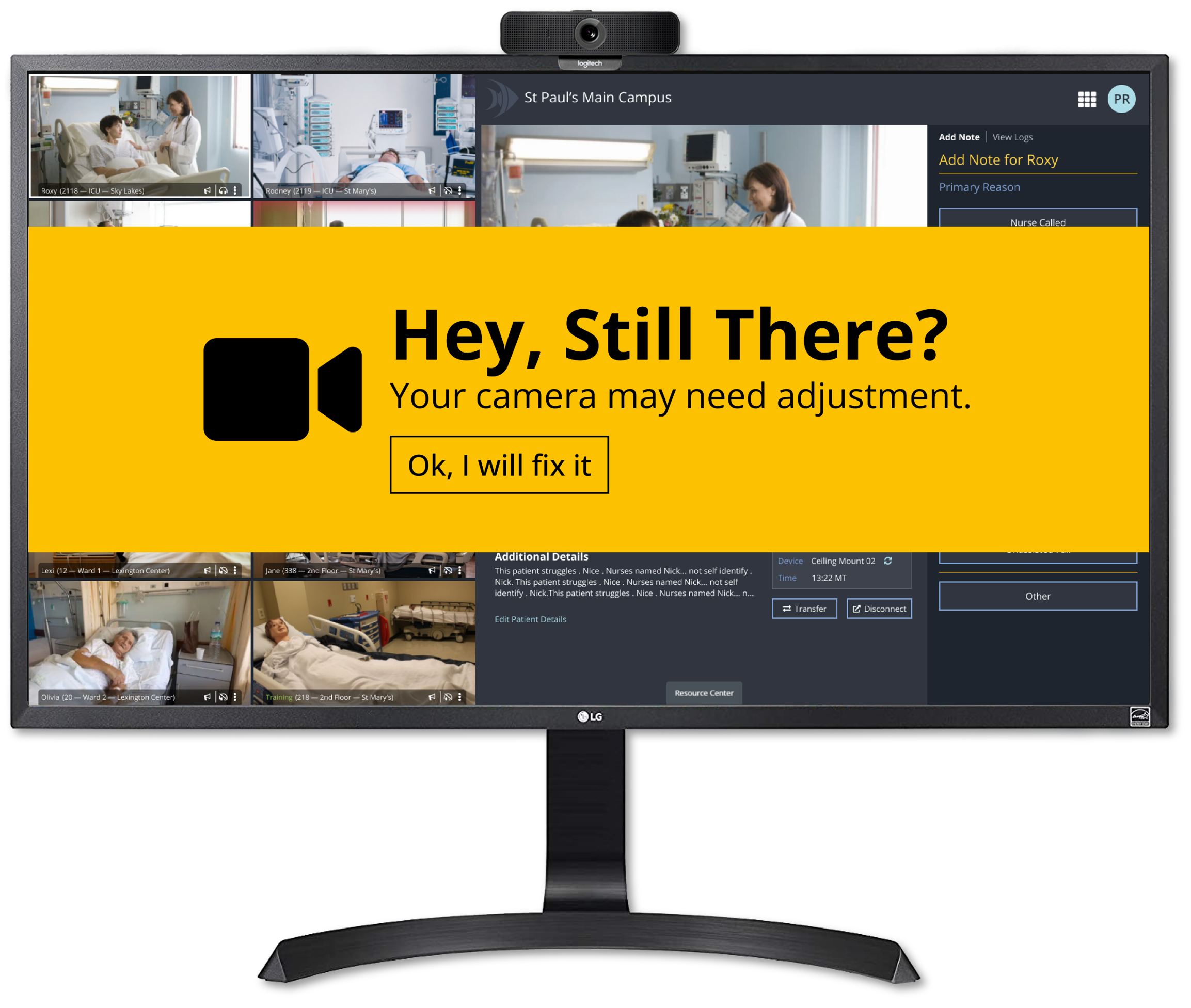
The feature needed to do more than detect presence. It had to respond appropriately when a sitter was not detected, support supervisors, and create useful documentation.
The experience combined several capabilities:
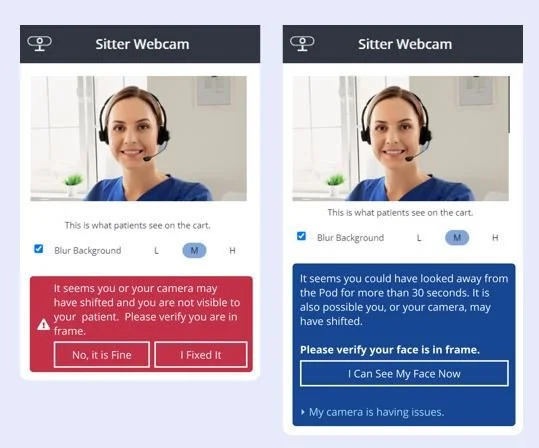
Presence verification: Computer vision to help confirm sitter presence.
Progressive nudges and reminders: Gentle prompts that escalate over time rather than immediately resorting to punitive alerts.
Configurable thresholds: Adjustable presence windows aligned with hospital policies, staffing models, and patient acuity.
Documentation: Snapshot capture and presence logs to support audits and incident reviews.
Supervisor notifications: Optional email notifications to support operational oversight.
Together, these capabilities created a closed-loop workflow: detect, prompt, escalate when needed, and document. The design balanced operational accountability with a practical experience for sitters and supervisors.

Designing for Privacy and Trust
In healthcare, AI must earn trust. Presence detection introduces sensitive questions about privacy, surveillance, data ownership, and how automated decisions affect staff.
We addressed these concerns through a governance framework covering protected health information, data ownership, transparency around AI behavior, and clear boundaries between helpful automation and intrusive monitoring.
Accuracy was equally important. False positives and false negatives could undermine confidence in the system, so configurable thresholds and iterative validation were central to the product approach.
The objective was not simply to automate oversight. It was to make the system understandable, appropriately bounded, and useful within the clinical context.
Establishing a Foundation for Future AI
SPD was designed as the first step in a broader AI roadmap, not an isolated feature.
The patterns established through this work created a foundation for potential capabilities such as:
In-room context, including distinguishing patients, staff, and visitors.
Patient-state detection, such as resting, sleeping, or active.
Camera auto-tracking.
Sitter attentiveness and identity verification.
Detection of imbalances across patient pods.
These were future roadmap possibilities, not all capabilities delivered as part of SPD. The foundational work established technical, ethical, and workflow patterns that could support their later development.
Validating Before Broad Release
Because the feature operated in a safety-critical environment, rollout needed to build confidence in both system behavior and the user experience.
We used a phased approach:
Beta testing with internal staff.
Revisions based on post-beta feedback.
Limited customer release.
Formal feature launch.
This progression created opportunities to refine accuracy, tune thresholds, and validate workflows before broader deployment.
The Outcomes
Sitter Presence Detection established a new layer of operational accountability for Collette Health's virtual observation platform.
Greater visibility: Hospitals gained a way to verify sitter presence rather than relying solely on manual oversight.
More consistent workflows: Automated nudges and escalations supported ongoing sitter engagement.
Improved documentation: Snapshots and presence logs supported audits, incident reviews, and quality reporting.
A foundation for future AI: The feature established reusable technical, ethical, and workflow patterns for subsequent capabilities.
Stronger platform differentiation: As Collette Health's first AI-driven feature, SPD demonstrated a practical application of AI within clinical workflows.
The Impact
Sitter Presence Detection demonstrated how responsible AI can become a practical part of clinical operations when the experience is designed around real workflows, clear boundaries, and human trust.
By connecting computer vision with configurable controls, progressive escalation, and auditable documentation, I helped establish a foundation for AI-enabled patient-safety tools that could evolve with the platform.
The central lesson: successful AI product design is not just about what a model can detect. It is about how that capability fits into people's work, how its behavior is governed, and whether people can trust the system around them.
