Transforming the Moving Experience: Designing SCE&G’s Online Service Orders
Moving is one of the highest‑volume, highest‑friction customer journeys for any utility. At SCE&G, starting, stopping, or transferring service required long phone calls, manual data entry, and workflows shaped by decades of call‑center scripts. The early online version mirrored this complexity, resulting in high abandonment and low conversion.
Leading the UX redesign
As Senior User Experience Specialist, I led the design, testing, and refinement of the entire Start, Stop, and Transfer service experience. My goal was to create a fast, intuitive, fully automated process that reduced customer effort and eliminated manual back‑office work.
Designing for simplicity and speed
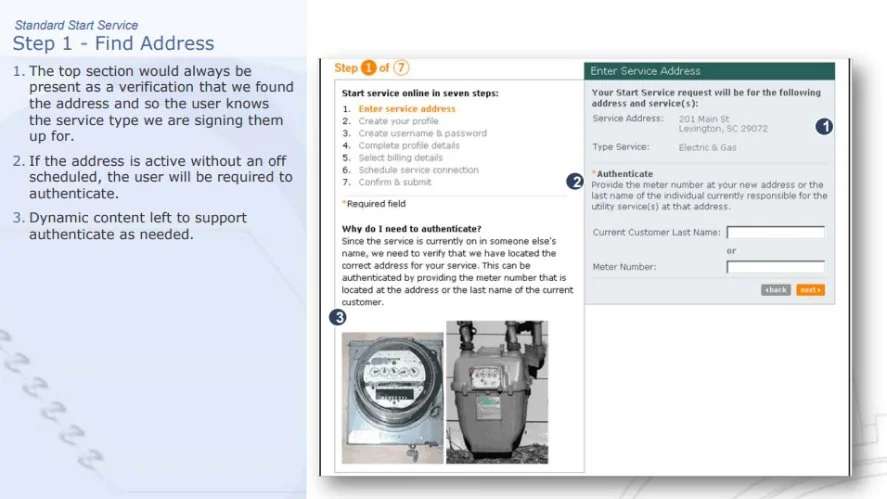
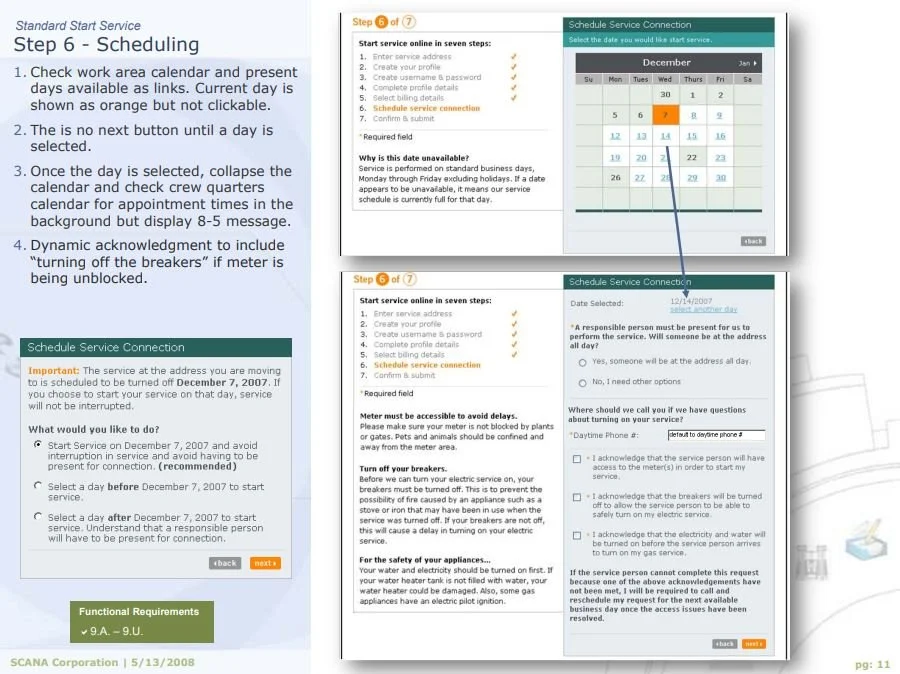
The original online flow took 15 minutes and included every question a CSR might ask. Through research and iterative testing, I reduced the Start Service flow to 3 minutes and simplified Transfer and Stop Service into four‑ and three‑step processes. This shift dramatically increased completion rates and reduced customer frustration.
Solving the address‑matching problem
One of the biggest barriers to automation was inconsistent address data in the CIS. I redesigned the address‑entry workflow to begin with ZIP code and street number, then dynamically generate matching street names. This eliminated mismatches, reduced errors, and improved data quality.
Supporting both power users and guided users
Testing revealed two user types: those who wanted to move quickly and those who needed reassurance. I designed a layout that allowed experienced users to complete the form rapidly while providing optional guidance for those who needed it—reducing friction without slowing down confident users.
Validating through research
We conducted extensive internal and external usability testing before development. This ensured that the final design was intuitive, efficient, and aligned with real customer behavior.
Measurable impact
The redesigned Online Moving Center delivered:
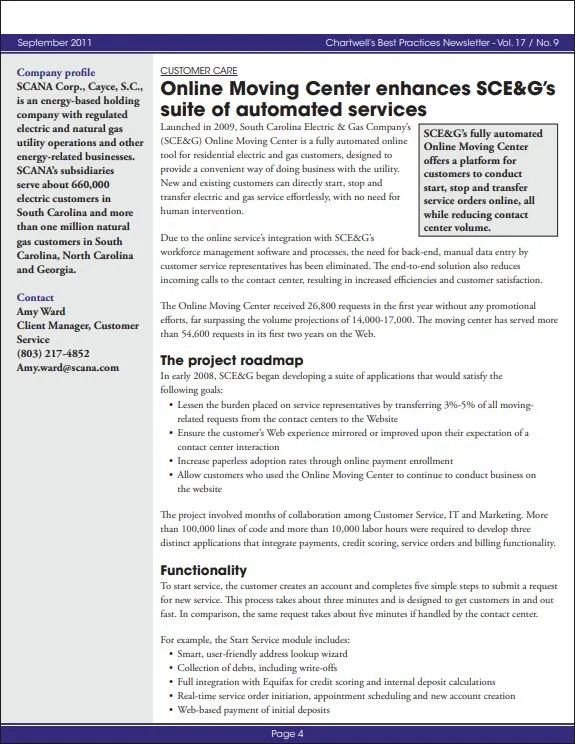
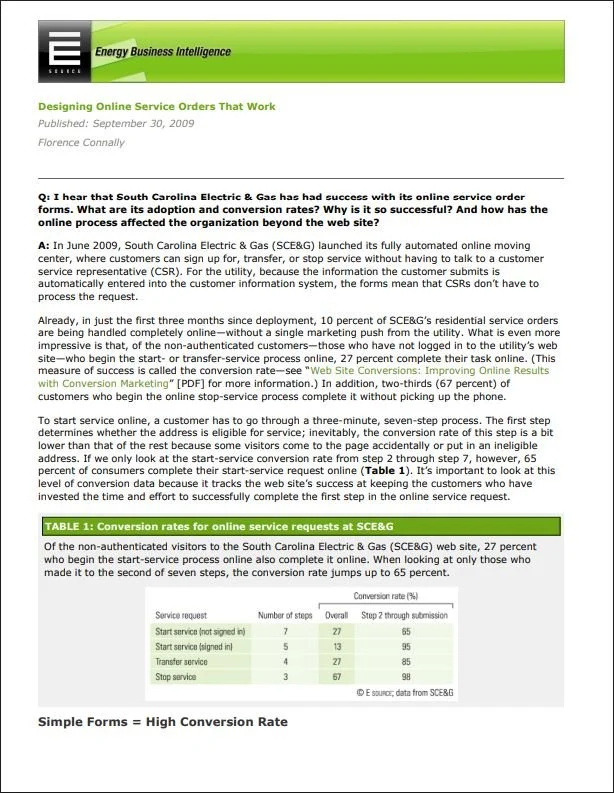
10% of all residential service orders completed online within the first three months
26,800 requests in the first year, far exceeding projections
Conversion rates of 65% (Start), 85% (Transfer), 98% (Stop)
80% fewer wasted field service calls due to improved data accuracy
Reduced call‑center volume and shorter handle times
This work demonstrates my ability to lead UX for high‑impact customer journeys, simplify complex processes, and deliver measurable improvements in efficiency and satisfaction.
Recognized by Chartwell and E Source as best practice.